
DFS Annual Meeting
Enabling collaboration between academia and the industry
8th and 9th of June 2026, University of Southern Denmark
The DFS Annual Meeting is the highlight of the year and brings together physicists from institutes, research groups and companies across the country for two days of exciting plenary talks about the latest research, thematic parallel sessions, a poster session with prizes, a 3-course dinner, socializing and network opportunities.
Why participate ?
- get an overview of companies in industry
- get an overview of the latest research from a variety of fields
- engage with different industrial and academic talents
- students are encouraged to show case a poster and can win the poster prize!
Who participates ?
- Industry ambassadors
- PhD talent and master students presenting their projects
- Young researchers establishing their impact in their fields
- Group leaders looking for talent and collaboration across academia and industry
- STEM graduates looking for jobs
Where and when:
- 8th and 9th of June 2026
- University of Southern Denmark – 0100 – Panoramudsigten – Indgang N, Campusvej 15
- is organized in collaboration with SDU TEK and Physics.
For young researchers and students in particular, the annual meeting is an excellent opportunity to present their work to their peers, and we encourage anyone interested to submit an abstract for a short presentation or a poster. Submissions are welcome in all fields of physics.
The program comprises of both plenum talks and sessions, as well as more specific science session in our tracks. This year we are happy to present our plenum speakers
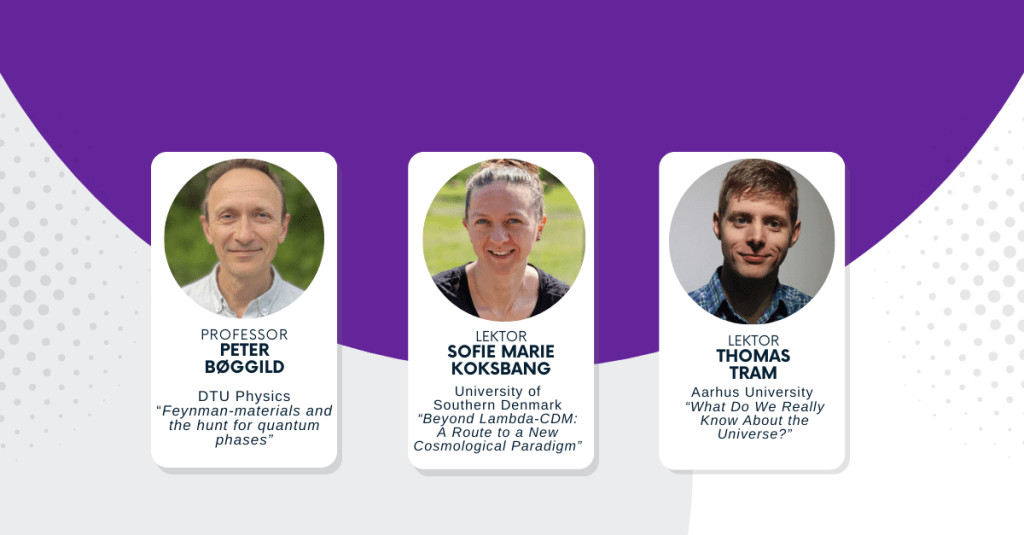
Hosting a session as chair is an amazing opportunity for young researchers, establishing their impact within a field with a mini-seminar of 90 minutes. All members of DFS are encouraged to chair a session. If interested, please contact mail@danskfysiskselskab.dk.
Free spots for Bachelor’s and Master’s students!
With the amazing support of our industri sponsors we are now able to offer:
- Free participation in the meeting – Value 1400 DKKR.
- A reimbursement grant up to 1000 DKKR to support accommodation
As part of the programme, participating students will:
- Submit an abstract for a poster or oral presentation
- Assist with a few practical tasks during the meeting
Please note that participants must be members of DFS. Student membership is 200 DKKR per year.
The amount of reimbursement depends on valid documentation of expenditures and will take place after the meeting.
Program

Sponsors:

List of abstracts
Day 1 – 8 June
Plenum Talk
-
What Do We Really Know About the Universe?
Associate Professor Thomas Tram
Department of Physics and Astronomy, Aarhus University, Aarhus C, Denmark
Quantum
Chair: Morten Bache, Novo Nordisk Foundation
-
Integrated Quantum Photonics Devices for Future Quantum Networks
Caterina Vigliar
Technical University of Denmark, Kongens Lyngby, Denmark -
Cavity Optomechanics with Suspended Resonant Mirrors
Aurelien Dantan
Aarhus University, Aarhus, Denmark -
Connecting Individual Atoms with Light
Jean-Baptiste Béguin
Niels Bohr Institute, Copenhagen, Denmark -
From Bell Violations to Trustworthy Quantum Technologies
Laura Mancinska
University of Copenhagen, Copenhagen, Denmark
NICE – Instrument Center for CERN Experiments
Chair: Ian Bearden, Professor, Niels Bohr Institute, KU
-
Seeing the Future in Photons: Fast ECAL Smearing Simulation Studies for τ Physics at FCC-ee
Leonora Misciattelli Mocenigo Soranzo
Niels Bohr Institutet, Københavns Universitet, København, Denmark -
Nuclear structure highlights in ultra-relativistic collisions at the LHC
Zhiyong Lu
Niels Bohr Institutet, Copenhagen, Denmark -
The ATLAS Inner Tracker for the High-Luminosity LHC
Thomas Schiøler
Niels Bohr Institute, Copenhagen, Denmark
Education
Chair: Sergio Ioppolo, Associate Professor, IFA, AU
-
AI in Higher Education from a Pedagogical Perspective
Mads Dahl
Aarhus University, Århus C, Denmark -
AI in Higher Education from a Lecturer’s Perspective
Jill Atsuko Miwa
Aarhus University, Aarhus, Denmark -
AI in Higher Education from a Student’s Perspective
Emilie Jørgensen; William Møller Johansen; Christoffer Emil Juul Hansen
Aarhus University, Aarhus, Denmark
Biophysics
Chair: Liselotte Jauffred, Associate Professor, DTU Bio
-
Cells as Soft Materials: Order, Disorder, Shape and Collective Behavior
Francesca Serra
Department of Physics, Chemistry and Pharmacy, SDU -
Cell Polarity: A Driver of Morphological Diversity and Robustness?
Ala Trusina -
The Force of Softness: How Cells Use Mechanics to Organize Tissues
Tianxiang Ma
Niels Bohr Institute, University of Copenhagen, Denmark
Industry I
Chair: N. Asger Mortensen, Professor, POLIMA, Mads Clausen Institute, SDU-TEK
-
Metalenses for Imaging
-
Copenhagen Microsystems
Anpan Han
Copenhagen Microsystems, Risø, Denmark -
ColorFoil – Non-Absorbing Customized-Colored Interlayers for Building-Integrated Photovoltaics
Catarina G. Ferreira
POLIMA — Center for Polariton-driven Light–Matter Interactions
Plenum Talk
-
Atomic Alchemy with Feynman-Materials
Professor Peter Bøggild
DTU Physics
Day 2 – 9 June
Plenum Talk
-
Beyond Lambda-CDM: A Route to a New Cosmological Paradigm
Associate Professor Sofie Marie Koksbang
SDU Physics
Industry II
Chair: N. Asger Mortensen, Professor, POLIMA, Mads Clausen Institute, SDU-TEK
-
From Photonic Chips to Companies
Nick Volet
Aarhus University, Aarhus, Denmark -
From Photonic Chips to Companies
Gerard Valentí-Rojas
Atom Computing, Copenhagen, Denmark -
Contribution from Sparrow Quantum
Oliver Luscombe Nørregaard
Sparrow Quantum, Copenhagen, Denmark -
Multispectral Imaging and Spectroscopic Analysis for Non-Destructive Investigation of Paintings
Mads Svanborg Peters
Newtec Engineering A/S, Odense M, Denmark
Subatomic
Chair: Ian Bearden, Professor, Niels Bohr Institute, KU
-
Improving Understanding of Nuclear Structures Utilising Bayesian Inference
Maxim Virta
Niels Bohr Institute, Copenhagen, Denmark -
Flow in Small Systems at the LHC
Martijn Laarhoven
Niels Bohr Institute, Copenhagen, Denmark -
Developments in Machine Learning for the ATLAS Experiment and the HL-LHC Environment
Daniel Murnane
Niels Bohr Institute, University of Copenhagen, Copenhagen, Denmark
Atmospheric Physics & Black Holes and Gravitational Physics
Co-Chair: Carol Anne Oxborrow, DTU Space & Marica Minucci, NBI
-
Monitoring a Warming World with Earthshine: Ground Observations, juLIET, and Máni
Peter Thejll
Danish Meteorological Institute, Copenhagen, Denmark -
Solar Nowcasting for National Energy Grid Planning
Elloise Fangel-Lloyd
Danish Meteorological Institute, Copenhagen, Denmark -
ASIM: The Atmosphere-Space Interactions Monitor
Carol Anne Oxborrow
DTU Space -
A Hyperboloidal Approach to Binary Black Hole Ringdown
Marica Minucci
Niels Bohr Institute, Copenhagen, Denmark
Nano Quantum
Chair: N. Asger Mortensen, Professor, POLIMA, Mads Clausen Institute, SDU-TEK
-
Prospects for Nonlocal Phenomena in Phonon-Image-Polaritons
Jacob Terndrup Heiden
University of Southern Denmark, Odense, Denmark & Korea Advanced Institute of Science and Technology, Daejeon, Republic of Korea -
Cavity-Material Engineering with Realistic Photonic Environments
Mikkel Have Eriksen
Technical University of Denmark, Kgs. Lyngby, Denmark -
2D Semiconductors as On-Chip Light Sources for Integrated Nanophotonics
Christian Frydendahl
Aarhus University, Aarhus, Denmark -
Velocity-Tunable Exciton-Photon Hybridization in Cathodoluminescence
Sven Ebel
POLIMA, University of Southern Denmark, Odense, Denmark
KIF prize winner talk
Chair: Maren Malling, Women in Physics
Poster Session
Chair: Børge Svane
-
QTLab@AU: Quantum Teaching Lab at Aarhus University
Emre Aslan
Aarhus University, Aarhus, Denmark -
X-ray and Neutron Analysis for Industry
Erik Stieper Brok
FORCE Technology, Brøndby, Denmark -
Modelling the Galactic Diffuse Emission of Very-High-Energy Gamma-Rays and Neutrinos
Léa Zoé Bingler
Niels Bohr Institute, Copenhagen, Denmark -
Initial Analysis and Characterisation of the Prototype FoCal H Hadronic Calorimeter for ALICE
Jeppe Jersild
Niels Bohr Institute, Copenhagen, Denmark -
Data Analysis of FoCal-H Test Beam Signals for Detector Response Characterisation
Daniel Borre
Niels Bohr Institutet, København, Denmark -
Cosmogenic Neutrino Halos of Ultra-High Energy Cosmic Ray Sources
Emma Bruun
University of Copenhagen, Copenhagen, Denmark -
Analysis of Energy-Response and Resolution in the FoCal-H Calorimeter Prototype
Holger Ekstrand
NBI, København, Denmark -
Performance Characterisation of the Prototype FoCal H Hadronic Calorimeter for ALICE
Kristian Faeste
Niels Bohr Institute -
Discovery of Shallow Non-Dispersive Bands in the Family of Mixed Transition Metal Dichalcogenides Co0.25NbSe(2-y)Sy Using Photoemission Spectroscopy
John J. Flounders
Aarhus University, Aarhus, Denmark -
Raman Spectroscopy of Metal–Organic Frameworks
Mohammad Elham Hussain
IFA, Aarhus, Denmark -
Probing the Onset of Collectivity with Identified Hadrons in Light-Ion Collisions at LHC-ALICE
Preet Pati
Niels Bohr Institute, University of Copenhagen, Copenhagen, Denmark -
Flow Cumulants as Probes of the Quark-Gluon Plasma
Misiki Bharadwaz
KU, Copenhagen, Denmark -
Study of Fourier Optical Cavities for Exciton Confinement in 2D Materials
Luigi Brusaferri
Danmarks Tekniske Universitet, Kongens Lyngby, Denmark -
Flow-Vector Fluctuations in OO and Ne-Ne at 5.36 TeV
Lukas Cernusak
Copenhagen University, Copenhagen, Denmark -
Probing the Origins of Collective Flow in Small Systems
Amalie Clausen
Niels Bohr Institute, Copenhagen, Denmark -
Studying the Emergence of Collective Flow in Small Collision Systems at the LHC
Dina Stryger
Niels Bohr Institute, København, Denmark - Education in the Era of AI
-
Two-Photon Polymerization-Printed Diffractive Optical Elements for Hyperspectral Imaging
Pablo González
Newtec SDU, Odense, Denmark -
Adapting Graph Neural Networks to Identify Exotic Physics in ATLAS High Luminosity Inner Tracking Detector
Simon Kjær
Niels Bohr Instituttet, KU, Denmark -
Development of a Computational Data Analysis Pipeline for 3D Hyperspectral Cubes: A Comparative Spectral Analysis of Daguerreotypes and Ambrotypes
Malte Grau
Department of Physics and Astronomy, Aarhus University, 8000 Aarhus C, Aarhus, Denmark -
Design and Optimization of Diffractive Optical Elements for Snapshot Hyperspectral Imaging
Annabell Hannibalsen
Newtec SDU, Odense M, Denmark -
Time Evolution of Polaritons from Coupled Light–Matter Dynamics
August Koppers
DTU, Kongens Lyngby, Denmark -
On Two-Plasmon Decay in Low Temperature Tokamak Plasmas
Marcus Nadybal
Technical University of Denmark, Kgs. Lyngby, Denmark -
Exploring Nuclear Shape in OO and Ne–Ne Collisions with ALICE at the LHC
Vojtech Machacek
Niels Bohr Institute, University of Copenhagen, Copenhagen, Denmark -
Cavity Materials Engineering: Light-Matter Ground States and Photonic Coherence
Max Matheussen
Technical University of Denmark, Kongens Lyngby, Denmark -
Searches for Spectral Upturns Due to Photon to Axion-Like Particle Conversions Using H.E.S.S. and Fermi-LAT and Observations
Dominik Pastuszka Malek
University of Southern Denmark, Odense M, Denmark -
Cluster Identification Using Gaussian Boson Sampling
Josefine Bjørndal Robl
Centre for Quantum Mathematics, University of Southern Denmark, Odense, Denmark -
Towards a Cryogenic Optical Filtering System for Background Suppression in High-Efficiency Single-Photon Detectors
Joakim Rosenkilde
University of Southern Denmark, Odense, Denmark & Deutsche Electron-Synchrotron, Hamburg, Germany -
Long-Distance Chip-to-Chip Entanglement Distribution over Multicore Fiber
Damien Roux
Technical University of Denmark, Kongens Lyngby, Denmark -
Implementation of Time-Bin Entanglement-Based QKD on a Silicon Nitride Photonic Integrated Circuit
Jan Scarabelli Calopa
DTU, Lyngby, Denmark -
Data Analysis on Cell Monolayers: How to Quantify Order
Julia Schmidt
SDU, Odense, Denmark -
Harnessing Topological Defects to Control Cell Organization and Contraction in Nematic Cell Layers
Grecia Maria Valenzuela Portillo
SDU, Odense, Denmark -
Safely Simplifying Redshift Drift Computations in Inhomogeneous Cosmologies: Insights from LTB Swiss-Cheese Models
David Sallingboe
University of Southern Denmark, Odense, Denmark -
nHESEL Simulation and Analysis of Heat and Particle Transport in the JT-60SA Tokamak
Johannes Koblitz Aaen
DTU, Kongens Lyngby, Denmark


